
Why Your Teeth Look Yellow Even Though You Brush Twice a Day
 by nowmedia
When Good Habits Aren’t Enough: The Real Reasons Behind Yellow Teeth
You brush morning and night. You might even floss regularly and see your dentist twice a year. So why does your smile still look dull, yellow, or stained in photos? If this sounds familiar, you’re far from alone, and more importantly, you’re not doing anything wrong. Brushing is essential for oral health, but it was never designed to reverse the kind of discoloration that builds up over months and years. Understanding why your teeth are discoloring is the first step toward actually fixing it, and Dr. Simon Roytberg, a dentist in White Plains, NY, and the team at Dental Group of Westchester see this exact concern every week from patients across Westchester County.
It turns out this frustration is more common than most people realize. Surveys show that the vast majority of people pay close attention to other people’s teeth—and a significant share of adults admit they hold back from smiling fully because they’re unhappy with how their teeth look, even when their oral hygiene routine is solid. In other words, a “yellow” smile isn’t a hygiene failure. It’s usually the result of factors that live outside the reach of a toothbrush entirely.
Are you ready to whiten your teeth with professional teeth whitening? Call or text us at (914) 683-5203 to schedule your appointment with our White Plains cosmetic dentist.
The Difference Between Surface Stains and Deeper Discoloration
Not all yellowing is created equal, and that distinction matters for figuring out what will actually help.
- Extrinsic (surface) stains sit on top of the enamel and come from what you eat, drink, and are exposed to day to day. These are the stains a toothbrush can sometimes reduce but rarely eliminates on its own.
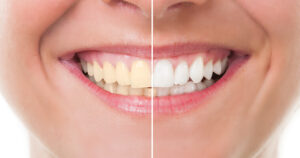
- Intrinsic (deeper) discoloration happens inside the tooth structure itself, often in the dentin layer beneath the enamel. No amount of brushing—with any toothpaste, no matter how it’s marketed—will reach this layer. This is the kind of discoloration that responds to professional whitening, not toothpaste.
Most people dealing with a yellow smile have some combination of both, which is exactly why a purely at-home routine often hits a plateau.
What’s Actually Causing Your Teeth to Yellow
- Diet. Coffee, tea, red wine, dark sodas, and deeply pigmented foods like berries and tomato-based sauces are some of the most common everyday culprits. These beverages and foods contain chromogens (color compounds) that cling to the pellicle, a thin protein film that naturally coats your enamel, which is exactly why stains can build up even with a diligent brushing routine.
- Tobacco use. Both smoking and chewing tobacco cause some of the deepest, most stubborn staining a dentist sees, and these stains tend to resist regular brushing far more than dietary stains do.
- Certain medications. Some antibiotics and antihistamines are known to cause tooth discoloration, particularly with long-term use, and in some cases, this type of staining can happen beneath the enamel surface where brushing has no effect at all.
- Age. As enamel naturally thins over the years, the naturally yellower dentin layer underneath becomes more visible through it. This is a normal part of aging, not a sign that your hygiene has slipped.
- Injury or trauma. A tooth that’s been knocked or cracked can darken over time as it heals, independent of anything happening on the surface.
The common thread here is simple: most of what causes yellowing happens at a level brushing that was never built to address. Toothpaste can help manage plaque and some light surface buildup, but it isn’t formulated to lift the kind of pigment and structural change described above.
Why This Matters More Than You Might Think
It’s easy to brush off (no pun intended) a slightly dull smile as a cosmetic afterthought, but the way people relate to their own smile has real, measurable effects. Research on smile confidence has found that a large share of adults notice other people’s teeth as one of the first things about them, and a meaningful percentage of people admit to holding back a full smile because they’re self-conscious about how their teeth look—even when nothing is actually wrong with their oral health. If brushing and flossing haven’t changed how your smile looks over time, that’s simply a sign you’ve hit the limit of what home care can do, not a reason to feel discouraged.
What Actually Works: Professional Whitening
This is where in-office, dentist-supervised whitening makes the difference that a toothbrush can’t. At Dental Group of Westchester, Dr. Simon Roytberg and the team use a professional-strength whitening process that’s monitored from start to finish—controlling the concentration and exposure time of the whitening agent so you get faster, more even, and more predictable results than store-bought strips, pens, or charcoal powders can offer. Most patients see a noticeably brighter smile in a single office visit, with the option of custom take-home trays afterward to maintain and touch up their results over time.
Because the treatment is supervised by a dentist, it’s also simply safer than experimenting with over-the-counter products on your own—your team can adjust the treatment if you experience sensitivity and can evaluate whether your discoloration is the type that responds well to whitening in the first place.

Schedule Your Professional Teeth Whitening in White Plains, NY
If you’ve been brushing diligently but still aren’t happy with how your smile looks, it’s time to talk to a professional who can tell you exactly what’s causing it—and what will actually fix it. As a trusted White Plains dentist, Dental Group of Westchester welcomes patients from White Plains, Scarsdale, Hartsdale, and Rye, NY, for professional, dentist-supervised teeth whitening.
Call or text us today at (914) 683-5203 to schedule your consultation, or stop by our office at 10 Mitchell Place, Suite #102, White Plains, NY 10601. Let’s find out what your smile is really capable of.